🎙️ Kitchen Recording by Miranda Kibel
Poetic adaptation & visual prompts generated by gemma-4-12b-heretic-styletune-head.i1-Q4_K_M
Audio Recording
Raw Transcript
So, Dad, you claim that I was unnecessarily multiplying entities. But actually, if my system is batshit, it’s actually because I’m not multiplying entities. Because unlike most systems, you have God in heaven and he keeps the dead from appearing as ghosts. He just keeps them safe in heaven. We’re safe from them. They’re safe from us. In my system, no such thing applies. You can actually summon ghosts ad infinitum. And some of them might actually end up suffering as a result because if the right mental illness is there, their emotions become identical with yours. And the reason I came to this conclusion is because I decided that if you reverse the tele-transportation paradox, you could decide that the memory of someone is that person. And then if that memory then gets tortured, that is the person being tortured. Though the thing is, I guess… That doesn’t really work because we still have memories of people when they’re alive. But this is just like… People… What people think are ghosts are probably memories. So then, like, if you decide… If you decide… Unless… If you decide that… Actually, I just realized my system isn’t actually that logical at all. But this is an example of not multiplying entities enough because in the system, in order to prevent this confusion of ghosts and memories, you can multiply the system… So that there’s the memory and then there’s the memory and then there’s the memory and then there’s the memory and then there’s the memory and then there’s the memory and then there’s the memory and that’s separate. My system, you combine the two together and then that results in madness. Literal madness in which a ghost suffers because it got caught in the human brain. I just realized that under open individualism, it actually might make sense when someone is dead to say that the memory is all that’s left of them and therefore it’s actually their spirit. And then that… So then that leads to the… But then if we decide that’s true, it moralizes mental illness. If someone ends up torturing their own brain by torturing the spirit. So by not multiplying entities, we actually end up torturing the spirit. So by not multiplying entities, we actually end up with a far more batshit system. That said, the system is actually functionally identical to an older system, potentially, because we used to have both Hecate and Hades. It’s possible Hecate can actually overpower Hades. So the idea then is that if you specifically appeal to Hecate, you could then summon the dead, at least briefly, and overpower Hades. If we assume this is true, then this is actually a similar thing to my system is that Hades. Then this is actually a similar thing to my system is that Hades can be overridden provided you’re willing to believe you actually summoned a ghost. It might not end well, but it’s possible. Well, under that system, of course. If I was to apply skepticism, I’d say, I don’t believe in ghosts. Unless we assume open individualism is true, then all bets are fucking off. Except actually, you don’t actually have to assume that with open individualism. You can just assume… But the thing about open individualism is that it only assumes one person exists. So it’s not so much that the memory of you. It’s not so much that the memory of you is you. It’s more that there’s only one person. And that person, every time one person hurts another person, that person is hurting themselves. Hence, by trying to summon the memory of you, the great person hurts themselves. Because they couldn’t accept and no one had died. Yeah. You may have been recorded. Anyway, so bachelory results, if you… I guess, though, the bachelory really comes from a bit of too much multiplication of entities because you were multiplied into both you and the memory of you. But then, in order to… If you’re going to multiply entities, you have to actually multiply entities more. Otherwise, you end up with bachelory. The way you have to multiply entities is that you then have to multiply the entity again to be you, memory of you, and ghost of you. If you don’t do this, if you only have you and memory of you, it could also be both you and ghost of you. So then, if you switch… If you end up with you, that ends up with that previously mentioned bat shittery of the torturable ghost. Because you could… If you’re mentally ill and you remember a ghost and then you torture it and then you become paranoid and you actually torture a ghost, then that’s basically the bat shittery that results when you… When basically you didn’t… You actually have the same number of entities, but you re… If you basically take the entities that exist and interpret them too mystically, then your last… Lack of multiplication of entities will actually result in paranoia and back shittery. So if you’re going to be mystical, you actually have to multiply entities. Otherwise, back shittery results. However, if you actually use certain systems as a reference point, you can sort of make yourself feel better without actually sort of… Without quite multiplying the entities, although… Although some people think it’s multiplying entities because it ends up using symbols, but those symbols are basically symbols of the limiting factors of what occurs in practice. Because in practice, people just don’t believe in ghosts and they’re not mentally ill. So torturing a memory in your head doesn’t actually result in anyone being tortured because no one’s actually feeling it under ordinary circumstances. If someone is feeling it, that suggests the presence of a mental illness.
Poetic Adaptation
The boundary thins where memory bleeds, The ghost becomes the thought that seeps, A singular soul in a fractured state, Where memory tortures the spirit’s gate. Without the divide, the self is torn, In the madness of a single entity born.
To save the mind from this haunted cell, One must multiply the layers of the spell— The self, the trace, the specter in the head, Or else the living suffer what the dead have fed. A mystical leap without a structured shore, Leaves madness knocking at the spirit’s door.
Yet Hades yields to Hecate’s ancient call, When symbols rise to build a protective wall. For unless we multiply the parts of being, The memory’s wound is the spirit’s screaming; A single thread pulled tight until it breaks, In the batshit logic that the lonely system makes.
Visual Scene Prompts
Prompt 1: A surrealist cinematic shot of a human silhouette standing in a vast, infinite library where the shelves are made of translucent glass; inside each glass pane, a different version of the same person’s face is flickering between a living expression and a ghostly, fading smile.
Prompt 2: A dark, moody macro close-up of a human eye where the iris is composed of swirling cosmic nebulae and clockwork gears; inside the pupil, tiny spectral figures are seen moving through a labyrinth of neural pathways that glow with a faint, sickly violet light.
Prompt 3: An ancient Greek temple ruins at midnight, where a dualistic shadow splits into three distinct forms—one solid and stone-like, one ethereal and smoke-like, and one flickering like a faulty neon sign—all connected by glowing golden threads of light.
Generated B-Roll Imagery
 A surrealist cinematic shot of a human silhouette standing in a vast, infinite library where the shelves are made of translucent glass; inside each glass pane, a different version of the same person’s face is flickering between a living expression and a ghostly, fading smile.
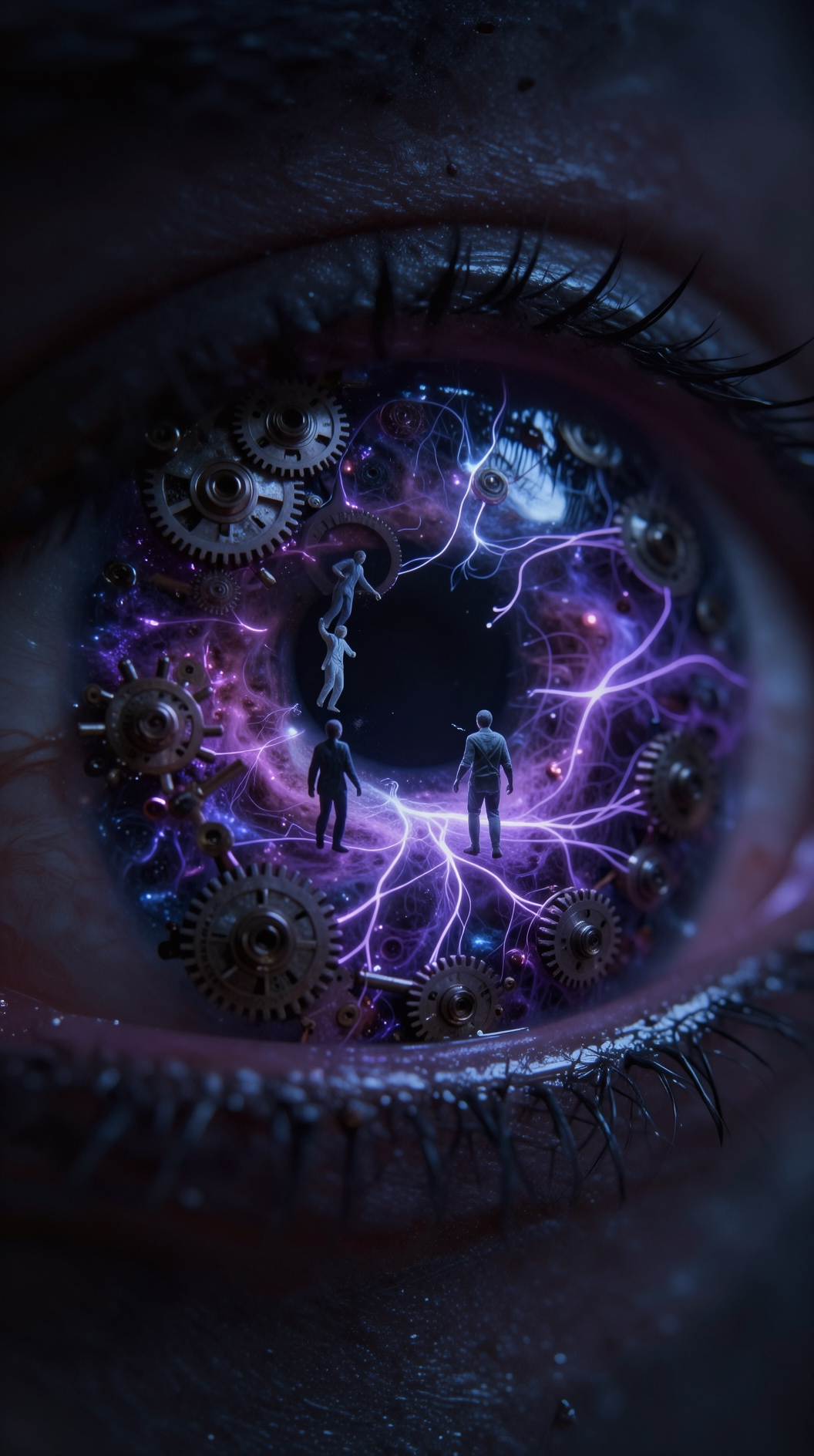 A dark, moody macro close-up of a human eye where the iris is composed of swirling cosmic nebulae and clockwork gears; inside the pupil, tiny spectral figures are seen moving through a labyrinth of neural pathways that glow with a faint, sickly violet light.
 An ancient Greek temple ruins at midnight, where a dualistic shadow splits into three distinct forms—one solid and stone-like, one ethereal and smoke-like, and one flickering like a faulty neon sign—all connected by glowing golden threads of light.