🎙️ Kitchen Recording by Miranda Kibel
Poetic adaptation & visual prompts generated by gemma-4-12b-heretic-styletune-head.i1-Q4_K_M
Audio Recording
Raw Transcript
So I think I finally found a conception of the nous that might be consistent with actual Neoplatonism. So in Neoplatonism, they had, I think, this concept from Aristotle called the unmoved mover, which I think may have actually been the same as Aristotle’s nous conception. And he seemed to think of it as aware of nothing but itself. But then if it’s only awareness and nothing but awareness, just aware of being aware. Now, I think technically the nous is a bit broader than the unmoved mover, but I think the nous, I suspect that the unmoved mover is where the nous is supposed to come from. So they took this concept from Aristotle and they decided to blend it with Plato’s world of forms. And eventually Plotinus decided that actually the world of forms is the nous. That’s how the world of forms exists. It’s apprehending itself via the nous, the awareness. And so I think that there is a collective awareness that doesn’t have a body. And that doesn’t sound possible. So I was like racking my brains over this, like, because I felt like there could be a materialist version of Neoplatonism in which our material bodies are actually causing Neoplatonism to be true in a sense. But this didn’t seem true because knowledge is not aware of itself, is it? Then I thought, wait a minute, I see knowledge in my head all the time. And also back in the day, they didn’t actually have a lot of forms. They maybe only had like a 500. Just model 500 forms, just model 500 forms, then make it a model that’s simultaneous. Like if you make a book of 500 forms, pretty much just the nous right there. And people, and the awareness does come from humans because everyone is, everyone knows that these forms exist. And if you just translate like the word noesis as like knowing instead of aware, then it makes sense. It makes sense. It makes sense. The thing is, it makes sense. The thing is, I think they may have thought it was actually even more aware than this. I think they possibly thought it was fully conscious, but at the same time, it also does not have an ego. And also, you could argue that, and it exists temporarily, so you could argue that it’s sort of like a metaphor for the timelessness of concepts. So as a model, at least, yeah, I think it actually does exist. It doesn’t really have the awareness we would think of it as having as like human awareness. The thing is, the Neoplatonists didn’t actually think of the Neoplatonists is having human awareness anyway. So I’m thinking I need to talk to an actual person who knows about Neoplatonism and try to confirm whether or not my conception is actually consistent with Neoplatonism. I didn’t think it was, but I think it actually might be consistent.
Here are the editorial components based on the lecture transcript:
Poetic Adaptation
Beyond the mover, still and unengaged, A mirror reflects a mirror, vast and deep. No body holds the shape of what is staged, Only the knowing wakes while others sleep.
The forms are gathered, five hundred in flight, A collective knowing, stripped of ego’s face. Not human thought, but timeless concepts’ light, Held in a mind that occupies no space.
A shared awareness, without a single hand, The architecture of ideas, suspended free. The Nous unfolds across the conceptual land, A timeless knowing, pure in its degree.
Visual Scene Prompts
Prompt 1: A vast, ethereal library without walls or floors where hundreds of translucent geometric sculptures float in perfect symmetry, each representing a mathematical form, bathed in a soft golden glow that emanates from the center of the space. Prompt 2: A macro close-up of a human eye where the iris dissolves into a swirling nebula of interconnected constellations and abstract symbols, representing the transition from individual perception to collective universal knowledge. Prompt 3: A minimalist, cinematic shot of a single drop of water suspended in mid-air against a stark white background, its surface reflecting an infinite kaleidoscope of classical Greek architecture and mathematical equations, symbolizing the Nous as a timeless concept.
Generated B-Roll Imagery
 A vast, ethereal library without walls or floors where hundreds of translucent geometric sculptures float in perfect symmetry, each representing a mathematical form, bathed in a soft golden glow that emanates from the center of the space.
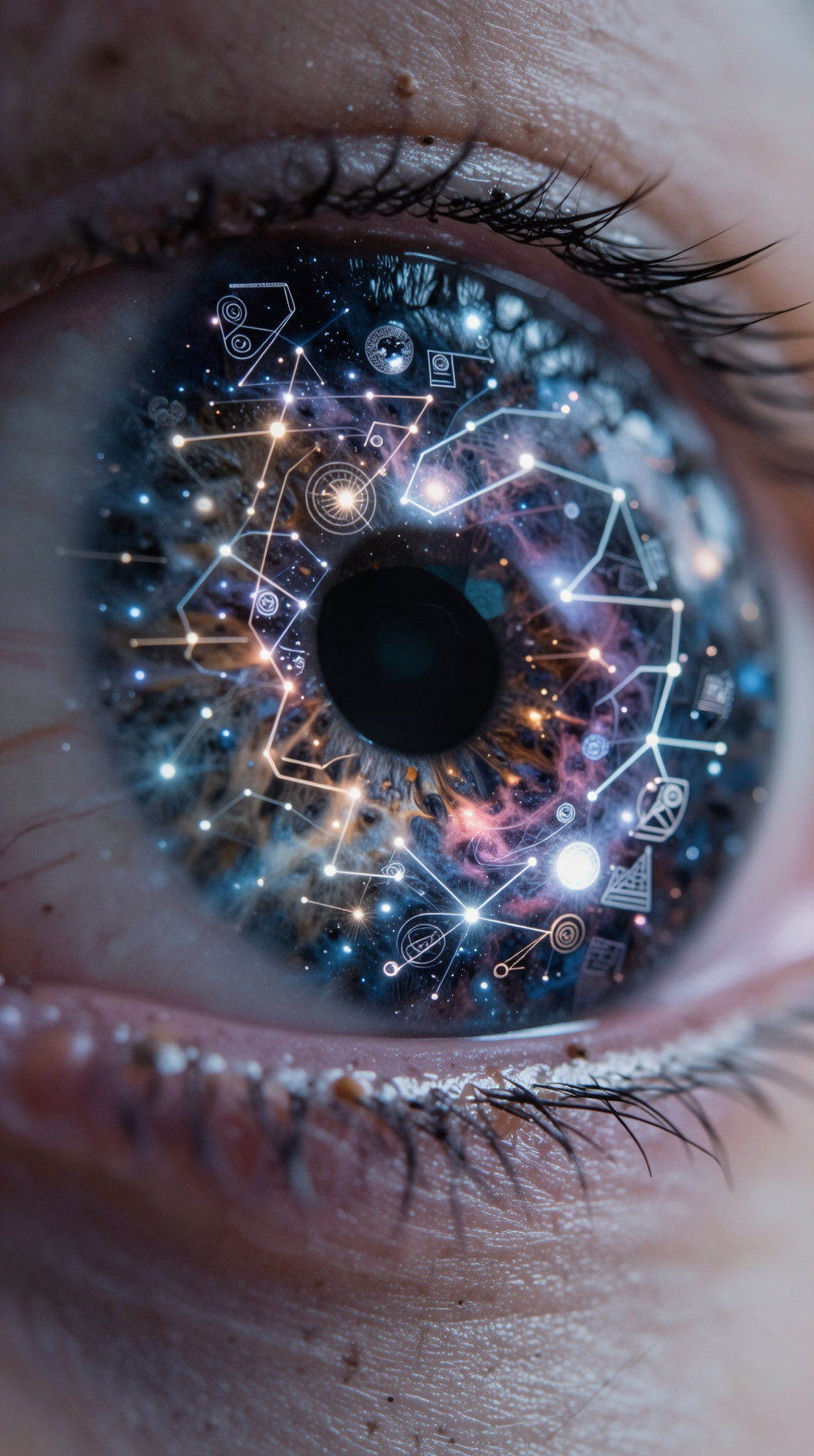 A macro close-up of a human eye where the iris dissolves into a swirling nebula of interconnected constellations and abstract symbols, representing the transition from individual perception to collective universal knowledge.
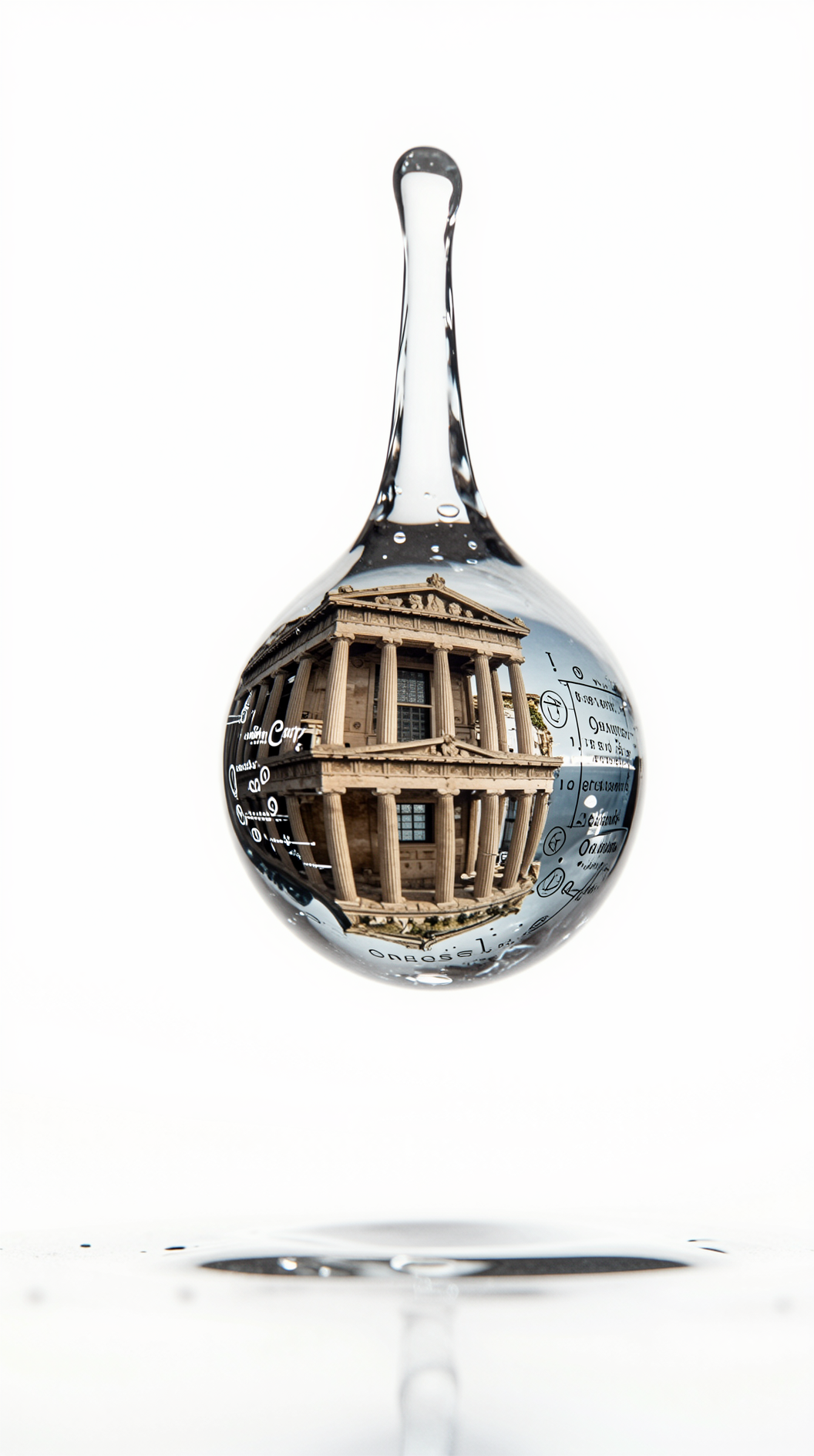 A minimalist, cinematic shot of a single drop of water suspended in mid-air against a stark white background, its surface reflecting an infinite kaleidoscope of classical Greek architecture and mathematical equations, symbolizing the Nous as a timeless concept.