🎙️ Kitchen Recording by Miranda Kibel
Poetic adaptation & visual prompts generated by gemma-4-12b-heretic-styletune-head.i1-Q4_K_M
Audio Recording
Raw Transcript
So about evangelicalism, evangelicalism doesn’t even just seem to be a thing in Christianity anymore. It seems to be a general religious trend where people are like, oh, I have discovered, it’s like the zealousness of a convert, really. It’s like, oh, I have discovered how much I love this God and I didn’t even really believe in the God before, but I love the God now. And I feel like I would be like this with Wicca and Greek religion. Greek ancient religion, I mean, if not for the fact that I am never actually a true believer, because I’m always forever a skeptic. I can only be agnostic at most. I can’t really prove the gods. So I decided I’d try to study Neoplatonism, because Neoplatonism seemed weirdly interesting. There was stuff about stuff being beyond existence or beyond consciousness. I’m like, wait, do me and this religion actually agree? Something beyond existence and beyond consciousness isn’t supposed to be a mere fiction. It’s supposed to be beyond. It’s supposed to be something very, very grand. And also, it’s supposed to potentially be containing existence within it somehow, or containing consciousness within it, or having a higher form of consciousness, maybe. It’s not exactly clear. For example, the henads, they are said to be supraconscious or beyond consciousness. They have consciousness folded up within them, but it seems more like they are data, but it seems more like they are data. That or the mouse monads are data. So this is an issue with Neoplatonism is that it seems to map the gods as data sets and then get suddenly horrified at what it’s done. Because once they go off the data sets, they don’t necessarily have a mechanism of consciousness because they don’t necessarily have a brain. Now, I feel like I solved this problem because data sets actually could be modeled as souls or spirits if you just have them allow them to be ignited. Allow them to be ignited. Allow them to be ignited by our brains. Allow them to be ignited by our brains. But no, that’s not good enough for Neoplatonism. But no, that’s not good enough for Neoplatonism. Because Neoplatonism isn’t supposed to say that consciousness comes from the brain. It’s supposed to say that consciousness actually comes from outside the brain. And indeed, we have a hard problem of consciousness. But I think I’m actually getting off track from my original point, which had to do with the evangelicals. And that is that people who are said to be very enthusiastic, and this is at least the case in Christianity, but I think it may actually be the case in other religions too, because the most enthusiastic. The most enthusiastic people are accused of having the worst theology. And I’m wondering what am I doing wrong exactly? Because I used to be sort of a militant agnostic. Like, you don’t know. And then I sort of became more like an evangelical saying, I know I have it right. I know I have it right. I’m 99% sure I have it right. And I’m so glad I found the model I found. Because the model I found of the gods is so true. Bless me. But then I found Neoplatonism. And I found, okay, maybe my model wasn’t actually quite correct. Except it actually, now I’m becoming more skeptical. I’m thinking, okay, I think my model was actually mostly correct. But it did give me some insights about what a spirit could be. And that I may have actually been on track when I thought that these thought forms actually could be spirits. But that probably isn’t a spirit, because a spirit is supposed to be something else. So my beliefs are possibly just resetting to what they were. It’s just more like re-mystifying things again. And it’s just, what exactly what exactly is supposed to be good theology then? Because the Episcopalians claim to have faith too. They don’t claim to be agnostics. So what exactly are they doing right? Is it just that they believe the official dogma? Is it just that they believe perfectly the official dogma? Is that what they’re doing right? And also like, why are they also like, but then why is there an inverse correlation between perfect theology and fervor? Is it because the, I’m guessing it’s because the good theology already incorporated is already incorporated disappointment somehow. Or it’s because they were born into their religion and just didn’t question it for some reason. I can’t really relate because I just recall my religion being extremely dry. Not totally dry, but like, it was always the, it was often dry in comparison to more ecstatic religions. But then more ecstatic religions, again, tend to be associated with bad theology. And I’m like, is this just a trap we’re in because we cannot have correct beliefs and not have correct beliefs and be enthusiastic about them at the same time. And I’m honestly confused as to why more people don’t do religious switching because familiarity breeds contempt. But I guess you could just jazz up the music and not actually change your theology. But I just am continually wondering if there’s any reconciliation between enthusiasm and bad beliefs. Can we have enthusiasm with good beliefs instead of bad beliefs? Can we?
Poetic Adaptation
The convert’s fire burns bright and wide, A fevered map where certainties hide. “I know the truth,” the zealous heart cries, While skepticism watches with ancient eyes. Yet fervor and reason walk separate halls— One builds a fever, the other a wall.
Neoplatonic shadows stretch across the mind, Where data becomes spirit, and souls are defined. Is truth a quiet dogma, inherited and dry? Or does the ecstatic leap miss the stars in the sky? Can we hold the flame without chasing the ghost, Or is fervor the price for the truth we love most?
Visual Scene Prompts
Prompt 1: A cinematic close-up of an ancient, dusty library where sunlight pierces through high windows, illuminating millions of floating particles of dust that transform into glowing geometric data points and ethereal golden threads of light.
Prompt 2: A split-screen composition: on one side, a monk in a grey stone monastery calmly reading a dry text in dim light; on the other side, a figure in ecstatic motion surrounded by swirling nebulas of cosmic energy and vibrant, chaotic colors.
Prompt 3: A surrealist painting of a human brain made of translucent glass, where glowing constellations of stars and mathematical equations flow outward from the center, dissolving into a vast, infinite ocean of clouds.
Generated B-Roll Imagery
 A cinematic close-up of an ancient, dusty library where sunlight pierces through high windows, illuminating millions of floating particles of dust that transform into glowing geometric data points and ethereal golden threads of light.
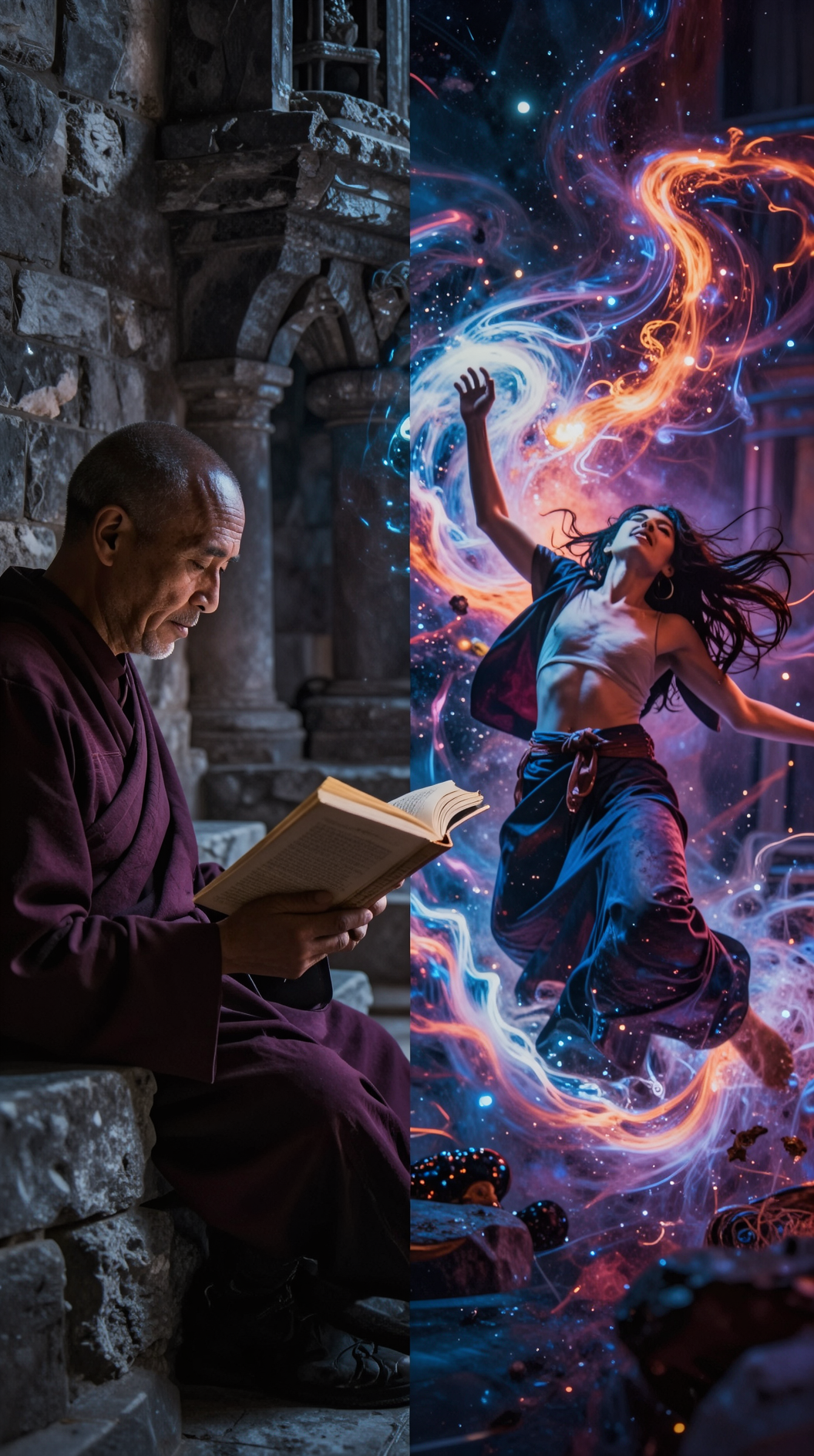 A split-screen composition: on one side, a monk in a grey stone monastery calmly reading a dry text in dim light; on the other side, a figure in ecstatic motion surrounded by swirling nebulas of cosmic energy and vibrant, chaotic colors.
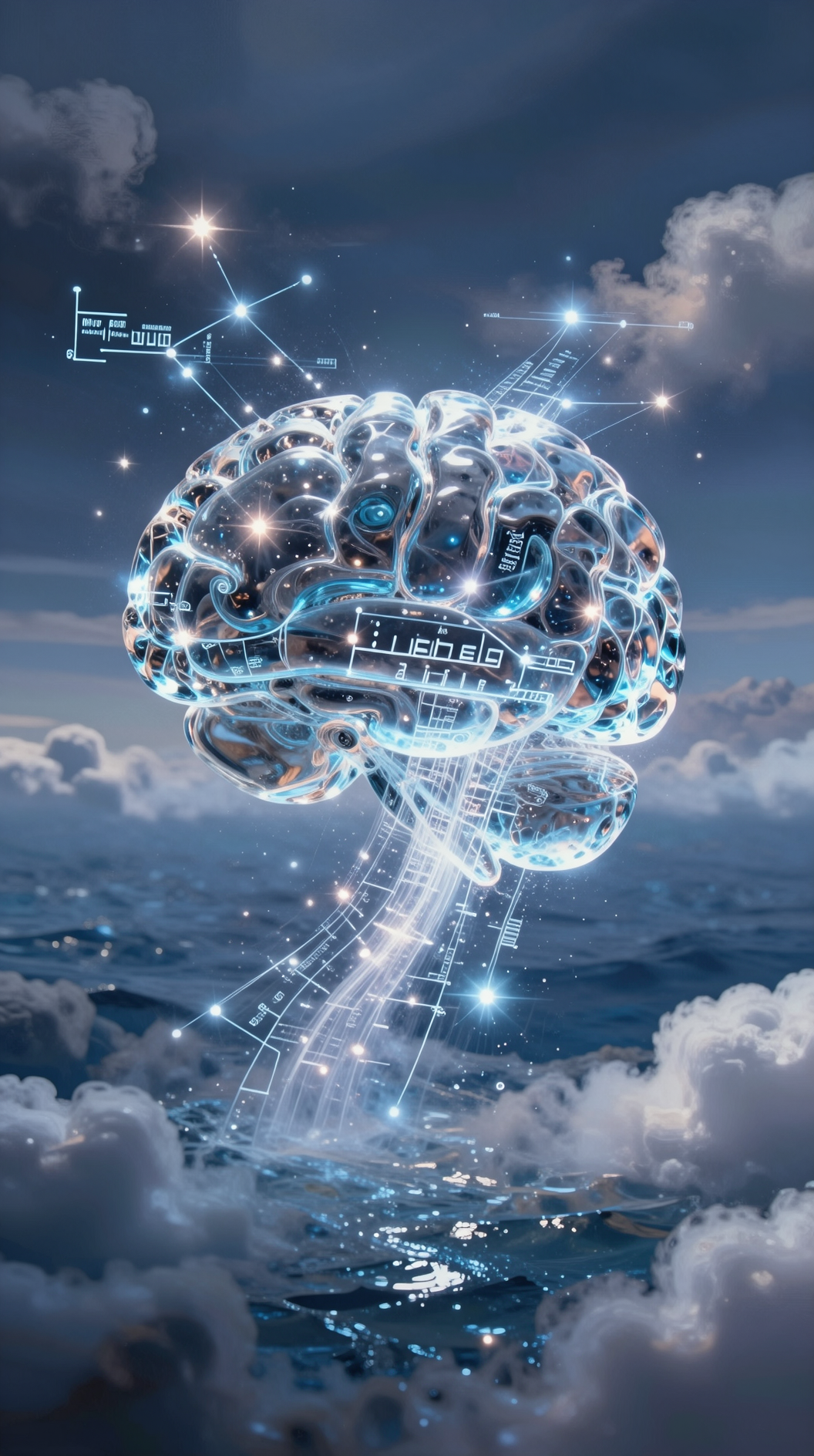 A surrealist painting of a human brain made of translucent glass, where glowing constellations of stars and mathematical equations flow outward from the center, dissolving into a vast, infinite ocean of clouds.