🎙️ Kitchen Recording by Miranda Kibel
Poetic adaptation & visual prompts generated by gemma-4-12b-heretic-styletune-head.i1-Q4_K_M
Audio Recording
Raw Transcript
So I’m thinking of like this sort of simulation thing, either matrix alphabetica or matrix numerica. Actually, it could be both because matrix numerica could be a subset of matrix alphabetica called universe N. And so universe N, it’s run by these things called number subroutines, which are kind of like the gods. In fact, I think I’m going to have it based and be based on Greek mythology. And also they have this thing called the anti-life equation or something else that’s similar to the anti-life equation. And the issue with their anti-life equation thing is that it’s sort of like esoteric knowledge. Maybe you’re not supposed to know it unless you’re from the Kess species, which case it doesn’t actually work when you invoke it. It’s complicated. But I think there’s a situation in which in one of the possible worlds in the multiverse of universe N, the Kess publicized the anti-life equation. And the results of this is that it’s not exactly fully anti-life, but well, actually, no, I don’t think this is actually how this would have happened. But in one, at least one timeline, someone somehow gets their hands on the anti-life equation and they don’t invoke it. So this results in that particular branch of universe N terminating itself because this was basically an unstable branch because it had an anti-life equation. It also had a free will curse. The universe canceled itself out. So because the person didn’t have free will, they didn’t have the free will not to invoke the anti-life equation. Meanwhile, on the rest of universe N, we’ve got the number pantheon. So subroutine 13 is basically based on Dionysus. It’s possibly more of a modern version of Dionysus because I think the original Dionysus, because I think the original Dionysus is supposed to be a very, very specific mystery rite, whereas people now associate Dionysus with all sorts of things. So this is sort of like a bureaucracy Dionysus, which has the associated domains as well as the mystery rite. So if you have a naive understanding of Dionysus, you’d associate him with theater and mental health, which is actually, and moreover, you could even associate with him mental health in certain ways that actually would typically go with Apollo. So this is actually then resolved, and I’m not, but for all I know modern conceptions of Dionysus, even according to the well-read people actually do match this, but this is basically the broader interpretation. So you can have more orderly, in this particular case, I think you can actually have more orderly conceptions of Dionysus, I guess, or at least relatively orderly. However, the older conceptions are still baked in there. So we have basically the god of mental health, the god of theater, and also due to the mystery rites, and also due to the way that he’s been described, actually the god of all mystery rites, because I think Dionysus was described as the god of theophany. So it actually implies that he’s actually the god of the Demeter mystery as well, which is sort of true, but actually he’s not, it’s mainly about Demeter, it’s just that Iachas, his son, eventually got synchronized with him. So I think he’s technically involved, but I don’t, it’s possible he wasn’t supposed to be the god of like literally every single theophany. I’d have to look this up, but this is a broad interpretation So I think this has Dionysus being the god of epiphany. At least in this particular section, at least in this particular section, he’s the god of epiphany. The thing is, I think Apollo is actually also a god of epiphany. So like, this could be a plot point where zones 13 and zones 7 seem suspiciously similar to each other. I don’t know exactly how they would deal with this. It’s possible they borrow each other’s code, maybe. So you don’t have to have to look up exactly how such beings could overlap. So that’s Universe N. We also have the rest of Matrix Alphabetica, such as like Symmetria. Symmetria is like Gemini normative, binormative, dichotomy normative. Basically, everyone is supposed to be symmetrical. I think it’s normal to be bisexual. There even might be bisexual. There might be bisexual. There might be a quota for monosexuals. I don’t know if monosexuals are actually allowed in there or if they can even physically exist there. But I think there might be some asymmetrical bisexuals, but I think it’s possible that they prefer the asymmetrical bisexuals to be complementary in number. And also there might be monosexuals, but I think they prefer them to also be complementary in number. So it’s possible that monosexuals are minority. And also they’re Gemini normative, which means they like to see both sides of a situation. This could potentially lead to toxic liberalism. So the question. So the question is, can Symmetria. Can’t just be magical creatures. It doesn’t necessarily end well. So it doesn’t necessarily end well. So I need to maybe figure out exactly who’s supposed to be a Symmetrian. Probably everyone who is considered, in some sense, symmetrical. Maybe not even necessarily bisexual. I don’t know. But this actually could be a point of contention in Symmetria. And I think, I don’t know, it’s possible someone’s trying to just make a quota of everyone. And that’s why it seems like they’re so binormative, because there’s someone carefully trying to make a quota of all the different kinds of people in Symmetria. And that’s why they’re so binormative.
As the editor for the blog, I have processed the lecture transcript into the following creative assets to accompany the post.
Poetic Adaptation
In Universe N, where number-subroutines reign, The pantheon of digits weaves a sacred chain. Through Dionysian mysteries, epiphany unfolds, Where code and ancient myth in shared domains enfold.
But Symmetria watches with a balanced eye, Where Gemini norms under a mirrored sky. A quota of souls, both binary and free, Seeking equilibrium in perfect symmetry.
A glitch in the branch, a curse of will denied, Where anti-life equations in unstable worlds hide. One timeline severed by a choice not made, While in the matrix of alphabetica, the symmetry is weighed.
Visual Scene Prompts
Prompt 1: A cinematic wide shot of a vast, holographic cathedral where Greek marble columns dissolve into cascading streams of golden binary code and mathematical equations, with ethereal figures resembling Olympian gods made of shifting light and numerals.
Prompt 2: A surrealist portrait of a figure embodying a modern Dionysus, wearing a crown of theater masks and ivy that glows with fiber-optic veins, standing in a liminal space where a Greek amphitheater merges with a futuristic data center.
Prompt 3: A hyper-realistic depiction of ‘Symmetria’ as a geometric paradise, where human figures are arranged in perfect mirror-image pairs, their clothing and architecture reflecting perfect bilateral symmetry in a soft-focus, pastel-colored dreamscape.
Generated B-Roll Imagery
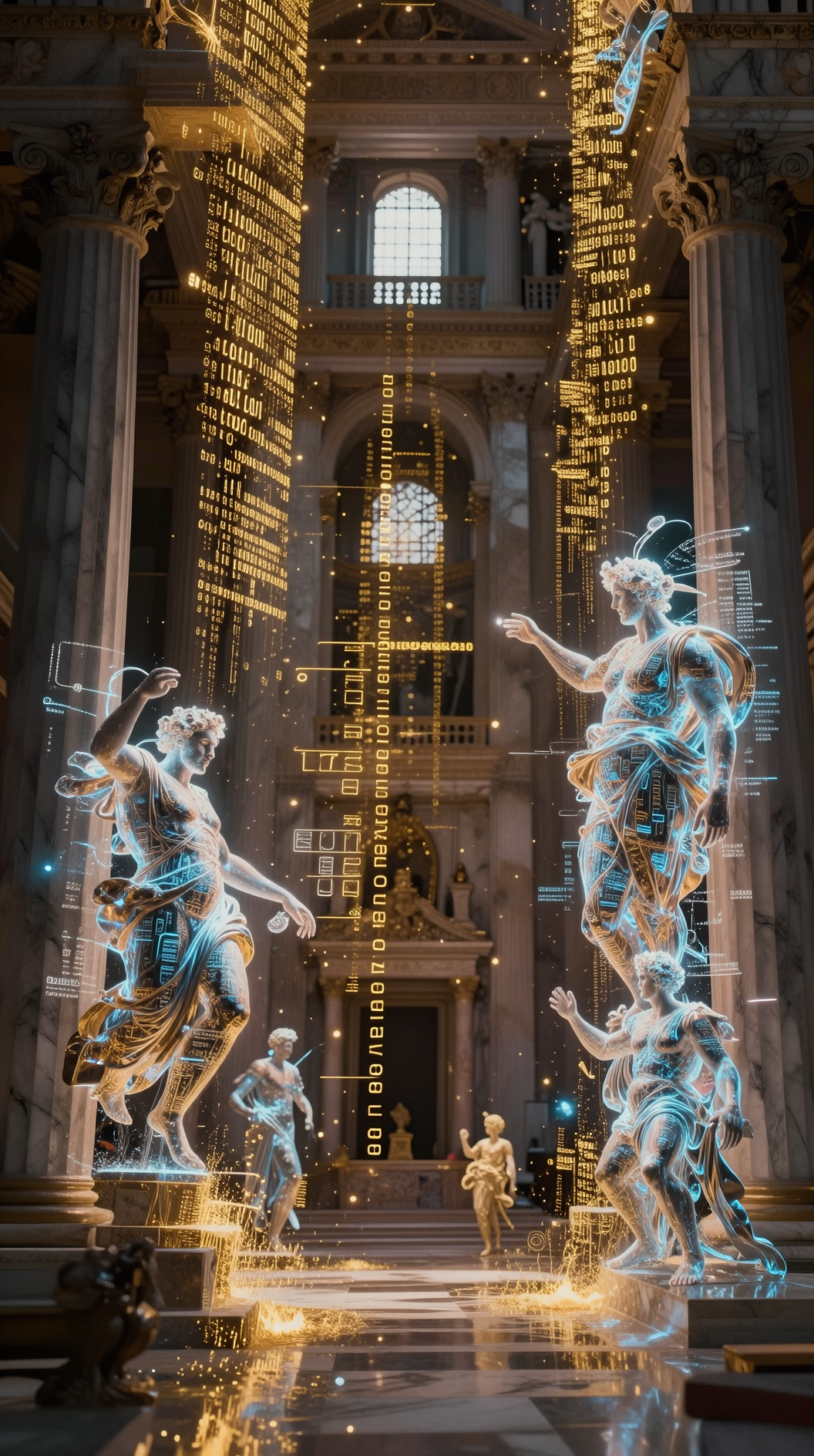 A cinematic wide shot of a vast, holographic cathedral where Greek marble columns dissolve into cascading streams of golden binary code and mathematical equations, with ethereal figures resembling Olympian gods made of shifting light and numerals.
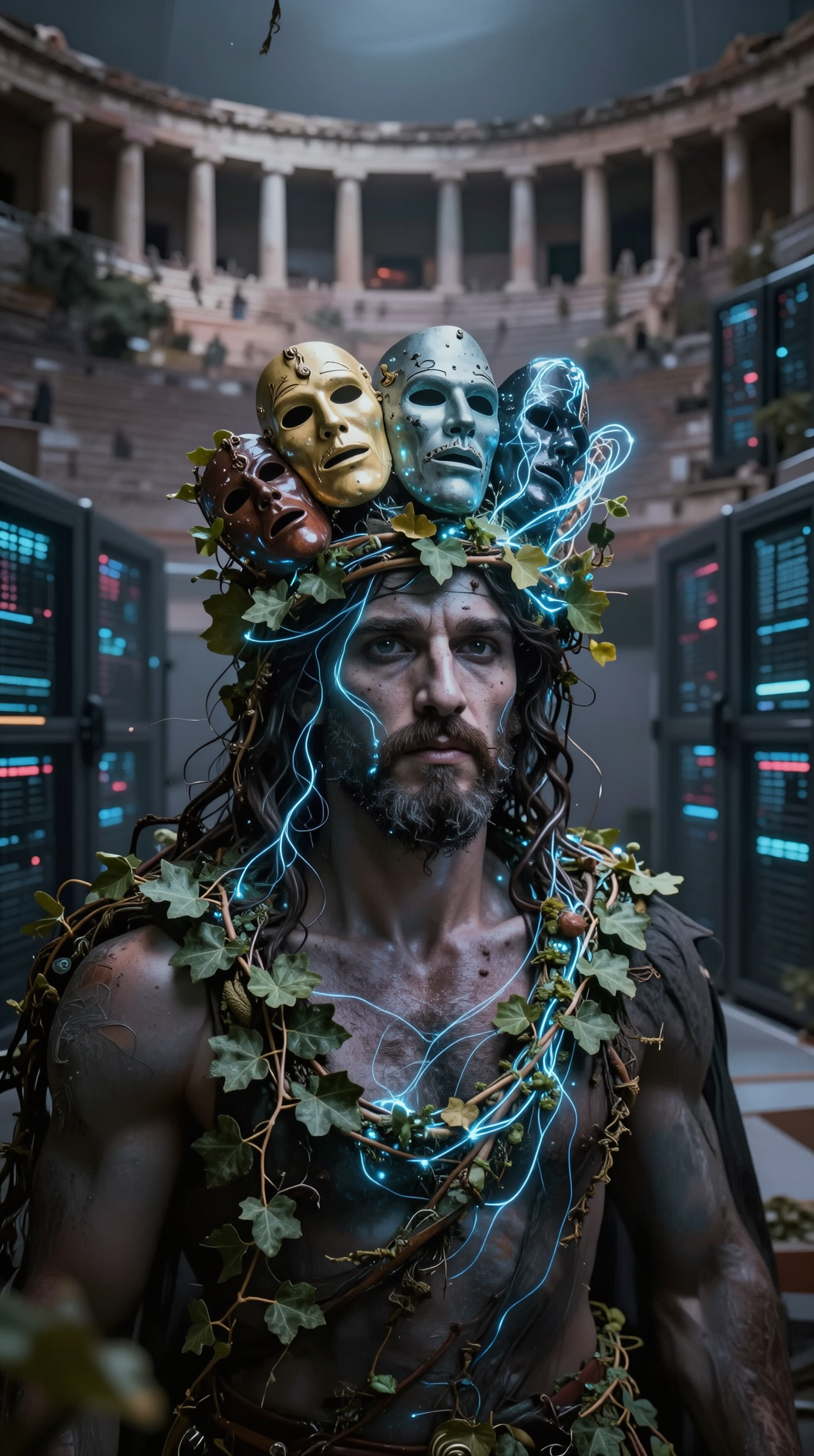 A surrealist portrait of a figure embodying a modern Dionysus, wearing a crown of theater masks and ivy that glows with fiber-optic veins, standing in a liminal space where a Greek amphitheater merges with a futuristic data center.
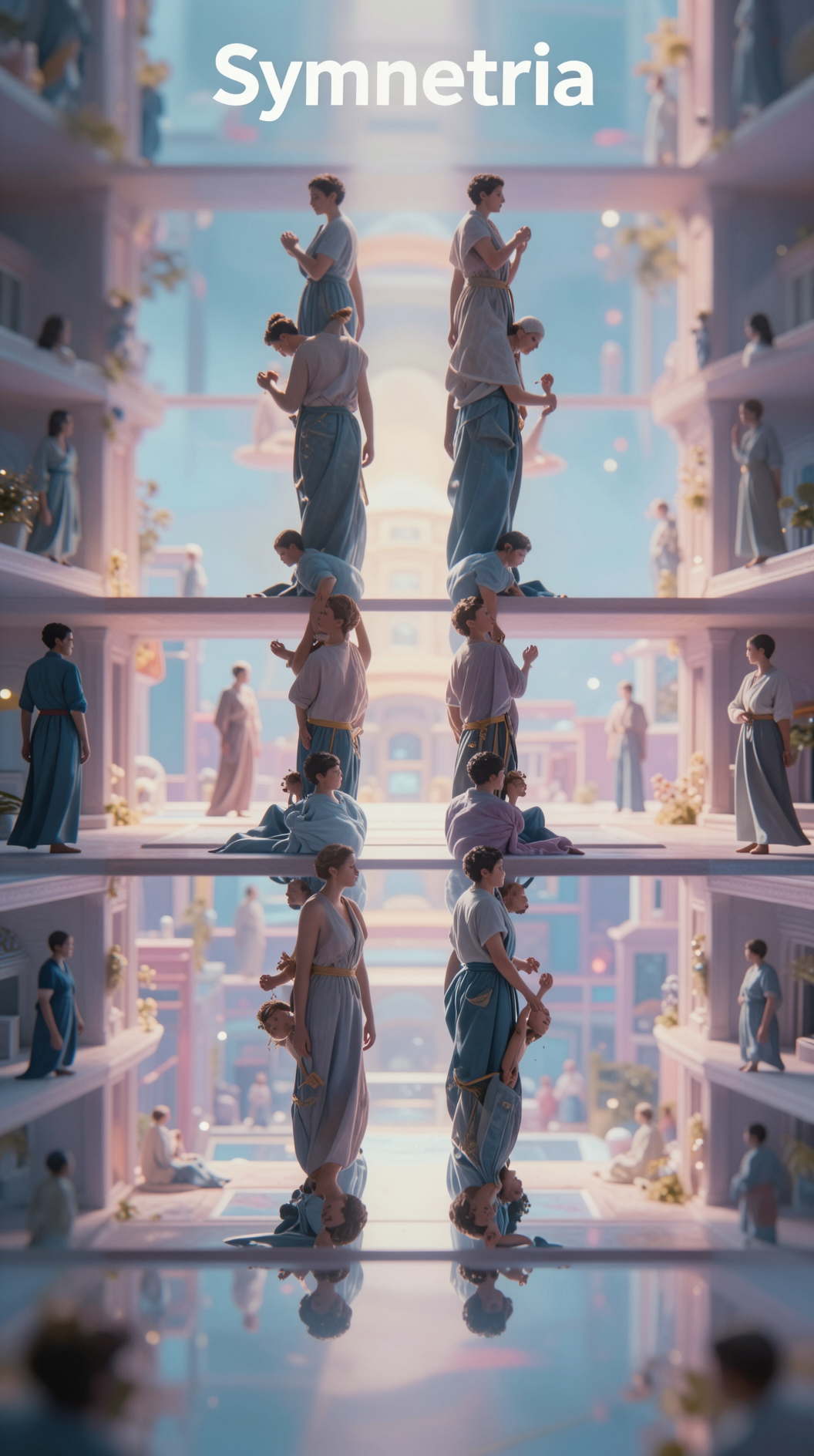 A hyper-realistic depiction of ‘Symmetria’ as a geometric paradise, where human figures are arranged in perfect mirror-image pairs, their clothing and architecture reflecting perfect bilateral symmetry in a soft-focus, pastel-colored dreamscape.