🎙️ Kitchen Recording by Miranda Kibel
Poetic adaptation & visual prompts generated by gemma-4-12b-heretic-styletune-head.i1-Q4_K_M
Audio Recording
Raw Transcript
So Descartes once said, I think, therefore I am. And that doesn’t quite mean what we think of it as meaning, because nowadays Buddhism is more in style. So we don’t necessarily think of our egos as fundamental. We are all aspects of the universe. Is there even an I? Buddhism says no. There is no self. Edward Butler disagrees. He goes by the Cartesian I. Descartes thinks that identity is the most fundamental quantity in the universe because it’s the only thing that can’t be broken down. This is a load of bullshit, as you can figure from Buddhism, which very much breaks it down. That said, I think you can’t always fully break down the organism I. So in a sense, there is a material I. But somehow Edward Butler, even though he’s not a materialist, he’s a Neoplatonist, he decided that not only is identity the most fundamental quality in the universe, it’s also fundamental for the gods. Specifically, the Hanads of the super-essential realm, which is effectively what the gods are in an extremely fundamental level of reality. Supposedly, at the most fundamental level of reality, where you have polytheistic gods, you have who-ness. They somehow have who-ness. They somehow have who-ness. They somehow have identity. Even though who-ness and identity is a human thing. And he admits they do not have human who-ness. But why would he apply this quantity to gods? Now, some people argue that you could argue that anthropomorphic personification is actually a self-fulfilling prophecy of truth, because several of these principles are actually modeled outside of time anyway. But the thing is, if that’s the reason that it’s the reason that it’s the person that it’s the person that it’s the person that it’s the person that it’s the person that it’s the person that it’s the person not specifically the Hanad, which, considering it exists beyond distinction, is arguably not a who or a what, but beyond that sort of thing. I therefore propose that Hanads are not what’s and Hanads are not who’s, but rather above both. I think it’s the person that it’s the person that it is. And that it’s the person that it’s the person that it’s the person that it is. But a who, but a who, but a what? And as a matter of fact, I think Heracles actually does not have his own Hanad. I think in the diagrams, I think he’s actually supposed to be descended from the Zeus Hanad. I could be wrong about this, but let’s say for the sake of argument, Heracles does not have his own Hanad. Heracles is not a who then. Zeus is. But here’s the thing about that. We have no material mechanism of Heracles being sentient in Heaven. We also have no material mechanism of Zeus being sentient in Heaven. What about fictional characters? What about fictional characters? Is Doctor Who a who? Is Doctor Who a Hanad? What about the god I invented as a child named Lord Mordecai, whose domains throughout my life have never really been entirely distinct from any god that actually exists, I guess? I think, I can’t remember what I said he was the god of, possibly art and music. The most I can think of making him is also the god of gatekeeping and religion. I’m pretty sure Greece. I’m pretty sure Greece already has gods for that shit. Is he a Hanad too? These beings seem more like monads at most. They are fictional characters. They are what’s. Or are they who’s? I don’t know. But if you say that the Hanads are fundamental who’s, then people are just going to say that their partners are Hanads because they are fundamental emotionally to them. If your system does not pass the Doctor Who, Superman, Lord Mordecai, meaning the fictional characters are just as divine as their gods, meaning the fictional characters are just as divine as their gods, it is not an objective system. That’s not to say it’s bad. I love pop culture paganism, but it is not an objective system.
Poetic Adaptation
Descartes claims the “I” is the bedrock stone, A fundamental unit, standing all alone. But Buddhism dissolves the self in the flow, Breaking the “who” to show what we know: That identity is a mask, a ripple, a seam, A fiction we weave in the waking dream.
Yet Butler climbs higher to the Hanad’s throne, Where “who-ness” is carved in the celestial zone. But can a god hold a name or a face? Or is identity just a human trace? If Zeus is a person, then what of the rest? Is a hero’s myth simply a divine test?
When fiction meets faith and the stories we spin, Does the Doctor or Mordecai let the truth in? If Superman’s mantle grants him a soul, Then “who-ness” is fractured, beyond our control. For a system of truth must stand firm and clear, Or drown in the stories we choose to hold dear.
Visual Scene Prompts
Prompt 1: A cinematic, surrealist wide shot of a marble statue of a Greek god cracking open like an egg, revealing a swirling nebula of golden light instead of flesh, neoclassical architecture crumbling in the background.
Prompt 2: A split-screen composition: on the left, a monk meditating in a minimalist Zen garden where his body dissolves into cherry blossom petals; on the right, a hyper-detailed Renaissance painting of a cosmic deity whose face is a kaleidoscope of shifting geometries.
Prompt 3: A moody, dimly lit study filled with ancient scrolls and modern comic books scattered on a mahogany desk, a single candle flame casting shadows that transform into the silhouettes of mythological heroes and fictional icons.
Generated B-Roll Imagery
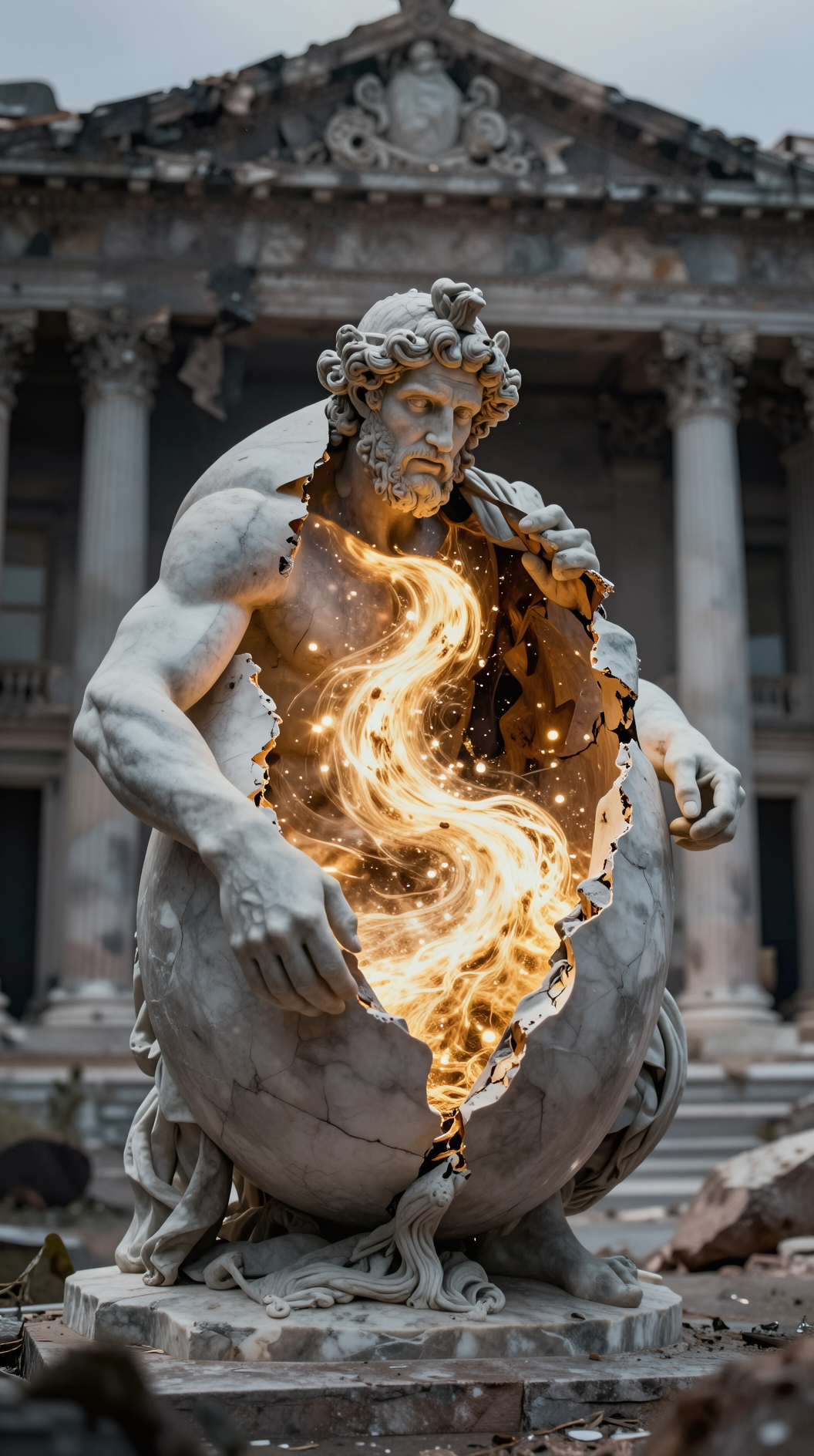 A cinematic, surrealist wide shot of a marble statue of a Greek god cracking open like an egg, revealing a swirling nebula of golden light instead of flesh, neoclassical architecture crumbling in the background.
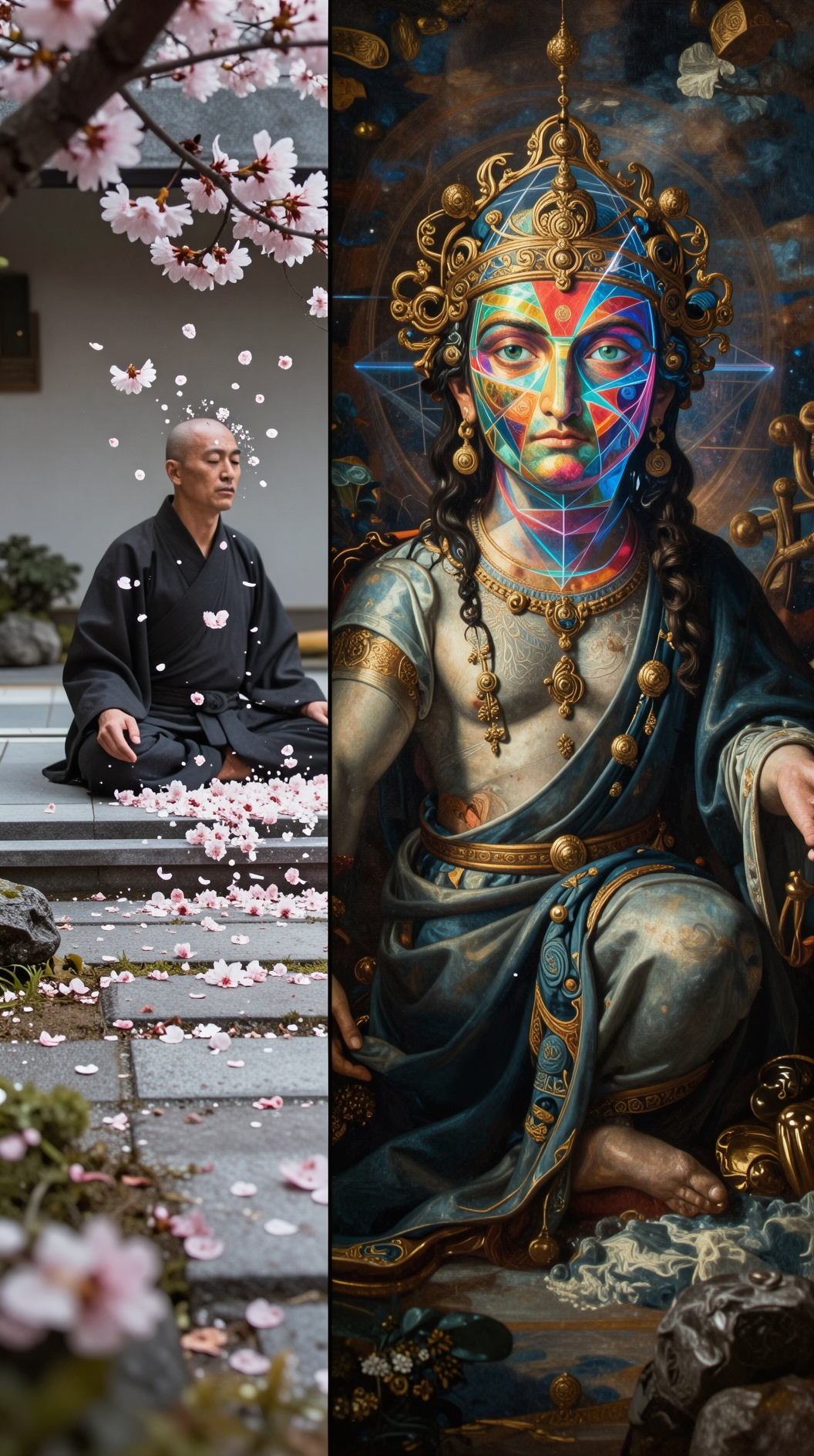 A split-screen composition: on the left, a monk meditating in a minimalist Zen garden where his body dissolves into cherry blossom petals; on the right, a hyper-detailed Renaissance painting of a cosmic deity whose face is a kaleidoscope of shifting geometries.
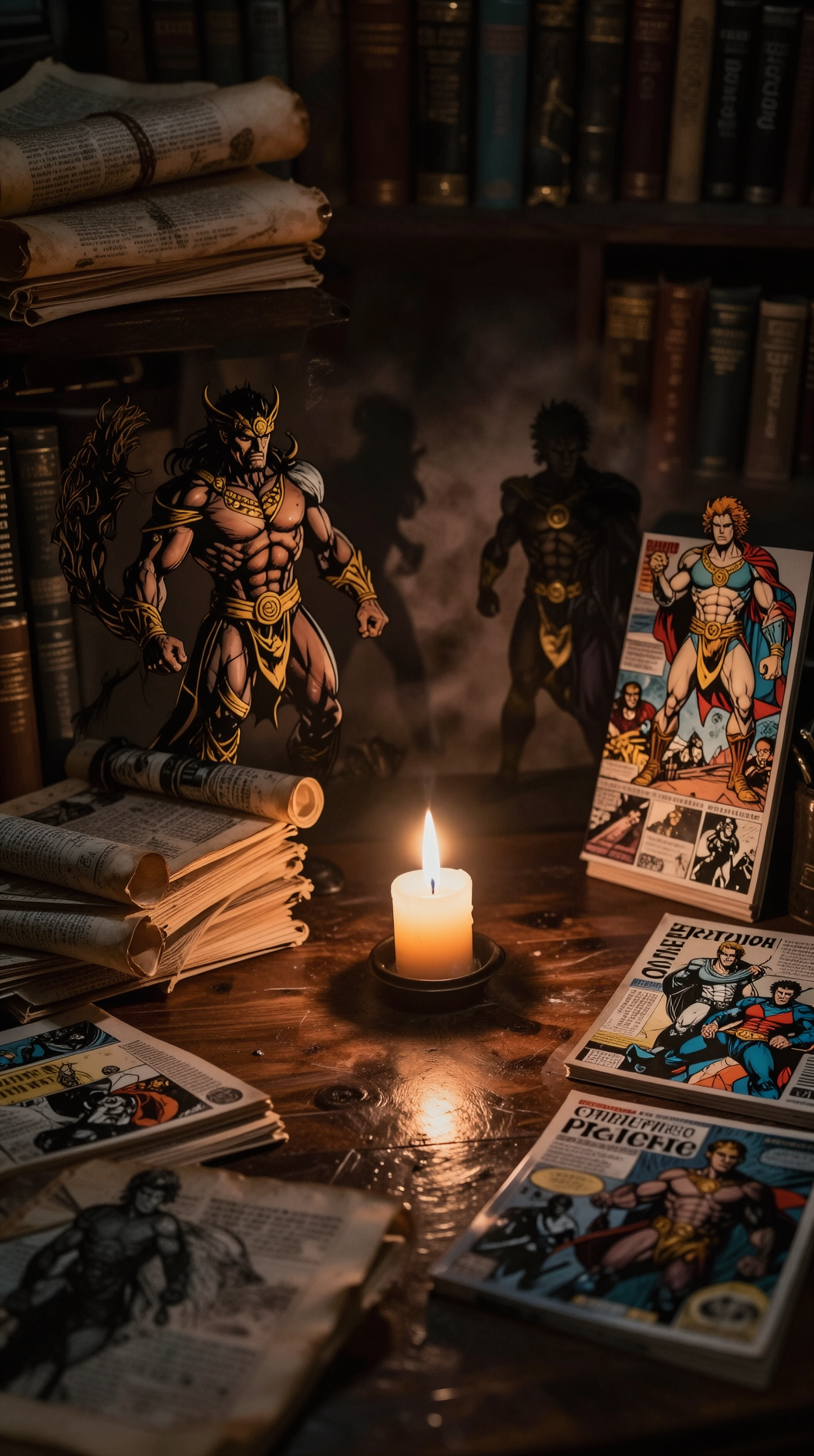 A moody, dimly lit study filled with ancient scrolls and modern comic books scattered on a mahogany desk, a single candle flame casting shadows that transform into the silhouettes of mythological heroes and fictional icons.