Audio Recording
Raw Transcript
So the thing with these ancient metaphysical systems is that they cancel each other out. So we first have Neoplatonism with its great reified things in the sky, like the noose and the world soul. But then we have Buddhism, which says stuff like there is no self, there is no consciousness. Any creator god is actually mistaken because they didn’t actually create the realm they’re in. I might be wrong on there is no consciousness part. That might be an exaggeration. But anyway, but then we have if anyone says there is no consciousness, then we have Descartes to say, I think therefore I am. And Aristotle to say principles are real, but they might disappear one day. And then it becomes one big argument of how long are these principles actually going to last? And are they real? And it becomes a bit of a moot point because as you get to monotheism, you decide, oh, all these principles schmints upon. They’re all just aspects of the universe. They’re all just aspects of the universe. They’re not actually God. God is outside the universe. And then Damascus of Neoplatonism is like, ah, yes, you mean the ineffable? And don’t get me started on the teletransportation paradox. This turns reincarnation into a huge paradox because the teletransportation paradox goes, basically, if you destructively teleport someone, is the new person actually is the new person that is the new person that is the new person who is the new person who is the new person who is the new person. And the new person who is the new person who is the new person who is the new person. And the new person who is the new person who is the new person who is the new person who is the new person who is the new person. And similar in Neoplatonism, it’s reincarnation. And now people are going to start thinking that maybe open individualism wasn’t such a good idea. And now depending if you think God is just, exactly how did he design this shit? Did he design it for infinite reincarnation or zero reincarnation? Which is the more just world? These Near Eastern traditions often say it depends on your behavior. But I don’t think God, there’s a God that actually has the capacity to regulate this. I don’t think there’s actually justice in the sky. I don’t think the afterlife actually punishes you based on your actions. I don’t think the afterlife actually punishes you based on your actions. The dying process can do that. I don’t think actual death can.
Poetic Adaptation
The stars are heavy, reified in stone, While Buddhist voids claim no self is known. A clash of systems, a canceling tide, Where gods are shadows with nowhere to hide.
The spark is copied, the body is torn, In the teleporter’s loop, a new soul is born? Or is it a ghost of a ghost in a shell, A recursive echo in a reincarnation cell?
No justice sits high in a celestial throne, To weigh the deeds of a life alone. Death is a process, a fading of light, Not a judge in the sky, but a fall into night.
Visual Scene Prompts
Prompt 1: A surrealist, cinematic wide shot of a vast, infinite library where massive marble statues of celestial figures are slowly dissolving into gray mist and empty space. Floating geometric shapes and glowing ancient scrolls drift through the air. The lighting is moody and ethereal, capturing the tension between solid metaphysics and the void.
Prompt 2: A high-concept visual of the teletransportation paradox: a human figure standing in a futuristic, ruined temple, being disassembled into thousands of glowing golden particles of light. On the opposite side, a duplicate figure is being reconstructed from the same particles, with multiple translucent “echoes” of the person overlapping to represent the crisis of identity.
Prompt 3: A hauntingly beautiful, close-up shot of a human face transitioning into a landscape of autumn leaves and sand. The features are blurring and drifting away into a deep, dark void. There are no heavenly lights or judges—only a slow, naturalistic dissolution of form, capturing the “dying process” as a transition rather than a destination.
Generated B-Roll Imagery
 A surrealist, cinematic wide shot of a vast, infinite library where massive marble statues of celestial figures are slowly dissolving into gray mist and empty space. Floating geometric shapes and glowing ancient scrolls drift through the air. The lighting is moody and ethereal, capturing the tension between solid metaphysics and the void.
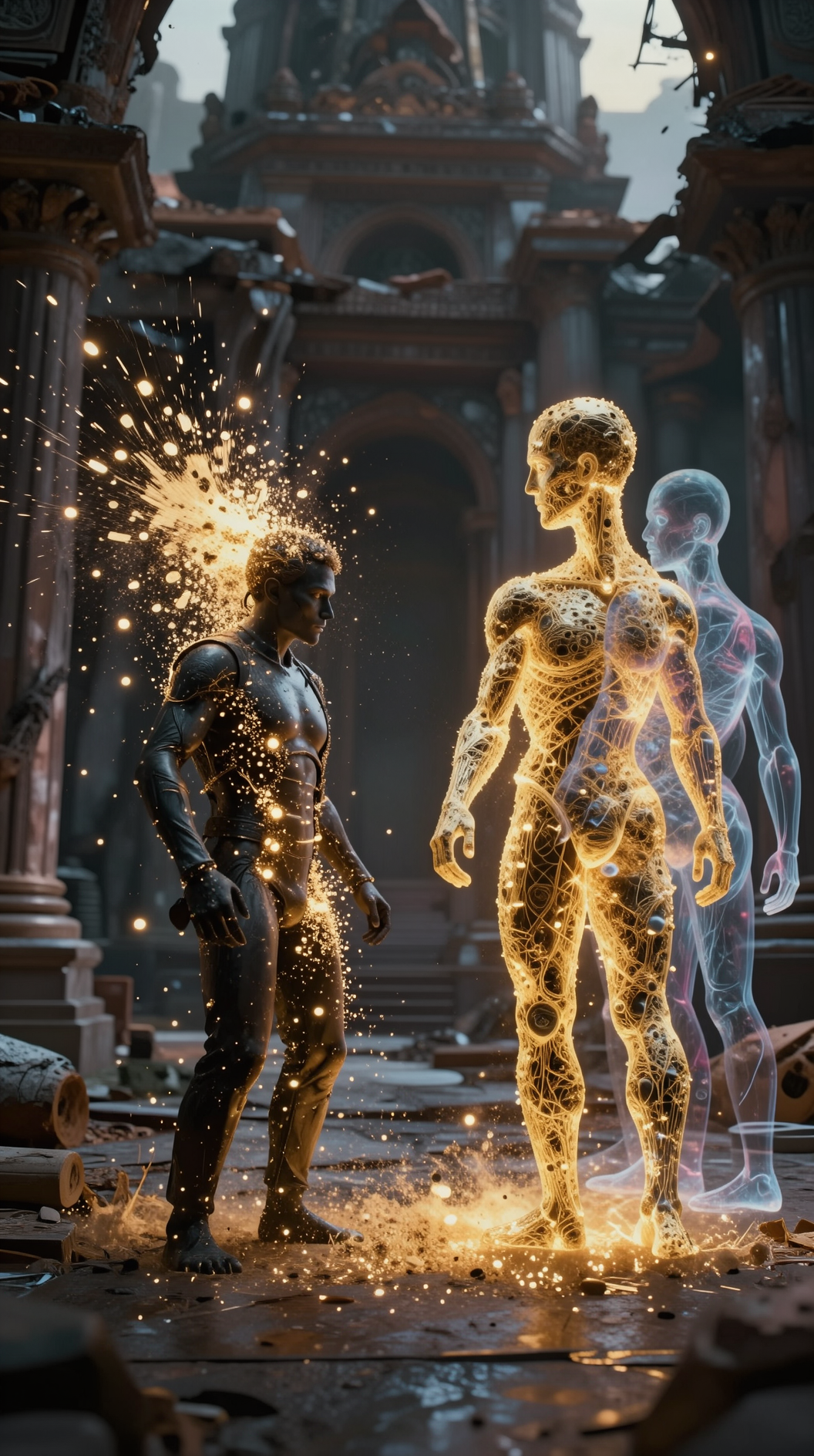 A high-concept visual of the teletransportation paradox: a human figure standing in a futuristic, ruined temple, being disassembled into thousands of glowing golden particles of light. On the opposite side, a duplicate figure is being reconstructed from the same particles, with multiple translucent “echoes” of the person overlapping to represent the crisis of identity.
 A hauntingly beautiful, close-up shot of a human face transitioning into a landscape of autumn leaves and sand. The features are blurring and drifting away into a deep, dark void. There are no heavenly lights or judges—only a slow, naturalistic dissolution of form, capturing the “dying process” as a transition rather than a destination.